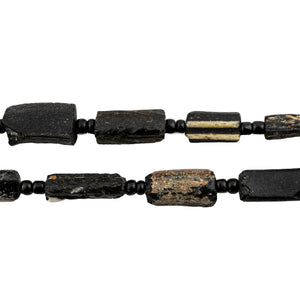
Jet beads are cut from jet, a hard, velvety-black organic gemstone formed from fossilized wood (a type of lignite, related to coal). Light, warm to the touch, and able to take a high polish, jet became famous in Victorian England for mourning jewelry. It's sometimes confused with black glass ('French jet') or onyx, but true jet is much lighter and warmer.
Types of Jet Beads
Hard jet — takes a high polish, most durable.
Soft jet — more prone to cracking.
Whitby jet — the prized English variety.
Often imitated by 'French jet' (black glass).
Jet Beads meaning & symbolism
Jet is associated with protection, grounding, and comfort in grief, and was traditionally worn for mourning and as a protective amulet.
History & cultural significance
Jet has been used since the Bronze Age and became hugely fashionable in Victorian Britain — Queen Victoria wore Whitby jet in mourning, sparking a major industry.
Where Jet Beads come from
The most famous jet comes from Whitby, England; jet is also found in Spain, the United States, and elsewhere.
●England & worldwide
How to identify Jet Beads
Genuine jet is very lightweight, warm to the touch, and deep matte-to-glossy black.
It's far lighter than onyx or glass.
Rubbed on unglazed ceramic, real jet may leave a brown streak.
'French jet' is black glass — cold and heavier.
How they're used
Mourning and Victorian-style jewelry.
Protective and gothic pieces.
Necklaces and bracelets.
Jewelry-making and collecting.
Buying guide
True jet is light, warm, and black — prized over black-glass imitations ('French jet'). It's relatively soft, so handle gently. Buy by the piece or strand.