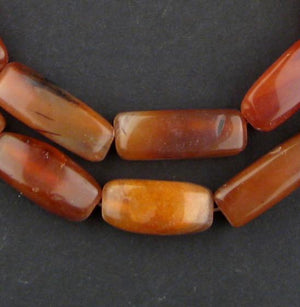
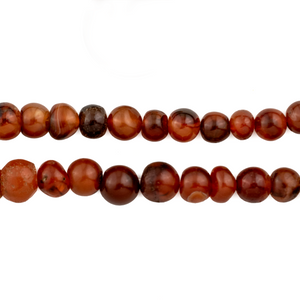
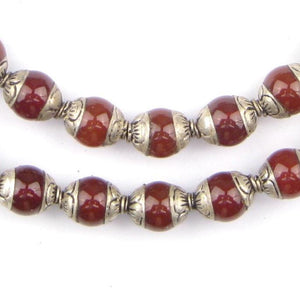
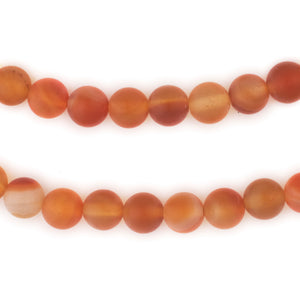
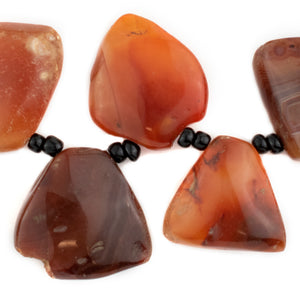
Carnelian beads are cut from carnelian, a warm orange-to-red chalcedony long used for adornment and seals, and associated with energy, courage, and motivation.
Carnelian beads are cut from carnelian, a translucent-to-opaque variety of chalcedony (a microcrystalline quartz, Mohs hardness about 6.5–7). Its warm orange-to-red color comes from iron oxide. A great deal of carnelian on the market is heat-treated agate — a long-standing, accepted practice that deepens and evens the color.
Types of Carnelian Beads
Natural carnelian — warm orange to brownish-red, often with a faint cloudiness.
Sard — a darker, browner relative of carnelian.
Carnelian agate — banded material; much commercial carnelian is heat-treated agate.
Color ranges from pale orange through to deep red.
Carnelian Beads meaning & symbolism
Carnelian has been prized since antiquity — used in Egyptian and Roman jewelry and signet rings — and is traditionally associated with energy, courage, motivation, confidence, and creativity.
History & cultural significance
Carnelian was among the most popular stones of the ancient world, carved into seals and amulets by the Egyptians, Greeks, and Romans — partly because warm sealing wax does not stick to it.
Where Carnelian Beads come from
Most carnelian comes from India and South America (Brazil and Uruguay), where agate suitable for the warm carnelian color is abundant.
●India, Brazil & Uruguay
How to identify Carnelian Beads
Natural carnelian often shows a slight color gradient or faint cloudy banding when held to the light.
Very even, intensely saturated color usually indicates heat-treated agate — a common and accepted treatment.
Genuine stone feels cool and has the hardness of quartz.
Dyed stone or glass imitations can look too uniform or show tiny air bubbles.
Reputable sellers disclose heat treatment.
How they're used
Bracelets and mala strands.
Necklaces, pendants, and rings.
Worn as an energizing, motivating stone.
Jewelry-making and design.
Buying guide
Most carnelian is heat-treated agate, which is normal and stable — just look for sellers who say so. Decide on color (pale orange to deep red) and shape (round, faceted, and barrel are common), and on size: 4–6mm for bracelets, larger for statement pieces. Buy by the strand and check the hole size for your stringing material.
Beads cut from carnelian, a warm orange-red chalcedony associated with energy and courage.
Is carnelian heat-treated?
Often — much carnelian is heat-treated agate, which deepens the color; this is common, stable, and usually disclosed.
How can you tell if carnelian is real?
Natural carnelian shows subtle color variation and the hardness of quartz; very uniform color is usually heat-treated agate, while air bubbles suggest glass.
What does carnelian mean?
Energy, courage, motivation, confidence, and creativity.
What are carnelian beads used for?
Bracelets, necklaces, rings, and energizing intention jewelry.